
Radiant Dark is puzzle-thriller game made by 15 students in a 20 week period. You play as Vivian Siegler, an agent of the CIA who is sent to recover research from a facility in Marie-Byrd Land, Antarctica.
I worked as the narrative designer on this game. For the first ten weeks, I was in charge of breathing life into our game through world and character creation. I made document libraries, dialogue for recordings, and a world bible to help us keep track of our narrative during our development phase. For the latter half of the development cycle, I collaborated with our 2D artist, Wren King, to make an art book for the game.
The Team
Producer – Chris Schickler
Environment Artist – Eli Gershenfeld
Level Designer – Kyle Hansleman
Sound Designer – Benton Pellet
Narrative Designer – Jessica Belote
Texture and 2D Artist – Wren King
Character Artist – Suh Kyung Lee
AI Programmer – Jerik Guzman
User Interface – Phillip Dove
Prop Artists – Jesse Ruffin and Christian Temporiti
Programmer/Artist – Armand Hebert
Animator – Nick Petko
Rigger – Justin Gray
Composer – Aaron Minich
Lore
During the Aleutian Campaign of World War II, US Army men discovered that members of the Alaskan Territorial Guard carried quartz and textured wood prayer pieces used to “commune” with the aurora. After these army men seized these prayer pieces and taped them to their powered off radios to mimic the members of the ATG, the aurora reached down from the sky and touched the quartz, and the soldiers’ radios began functioning.
This incident gradually made its way up the chain of command within the US army, until it made its way to Washington DC. With the recent success of the Manhattan Project and the events that followed the Solar Storm of 1859 in mind, the government started up a new secret project to study and potentially harness the aurora as a power source.
Two facilities were created: one in Barrow, Alaska, called Inua North and one in Marie-Byrd Land, Antarctica, called Inua South. They both had the same goal: research and harness the power of the auroras.
Inua South is where the events prior to the start of the game take place.
Between 1950-1960, Inua South’s research teams successfully figured out how to harness the power of the aurora. They also discovered, however, that the aurora was a sort of sentient entity. Early into researching how living things interacted with the aurora, a team of scientists, known as the scientists of Faraday Lab North or the North Team, discovered that the aurora could lash out and make humans into mindless, violent creatures, not dissimilar to zombies. Their research slowly turned from science to religion, and team North began worshipping the aurora. When they were discovered to be doing so by their supervisors, they were reassigned to other research teams, and the North lab was shut down.
January 12th, 1960, was the date the facility tried to fully contain the aurora. They had had success with smaller scale containment, and they eventually build equipment to full capture it. The only thing they refused to factor in was whether or not it wanted to be contained.
Years later, Vivian Siegler (the player) is sent by the CIA to Antarctica to find out what happened at Inua, beginning the events that unfold in “Radiant Dark”.
Development – Weeks 1-10
For the initial brainstorming of the world, I worked closely with our art director, Eli Gershenfeld. We worked together to decide a time frame for the facility to be operational in, as well as what it was used for, to help him establish an art direction. Once we had that framework set up, he began creating assets, and I continued to work on fleshing out the world.
I also worked with our Wren King, our 2D artist, to bring life to the documents we wanted to have scattered throughout the world. We discussed paper types, wear and tear, handwriting, and grunge that the documents would have, given the environment. She was absolutely wonderful to work with, on top of being a talented 2D artist.
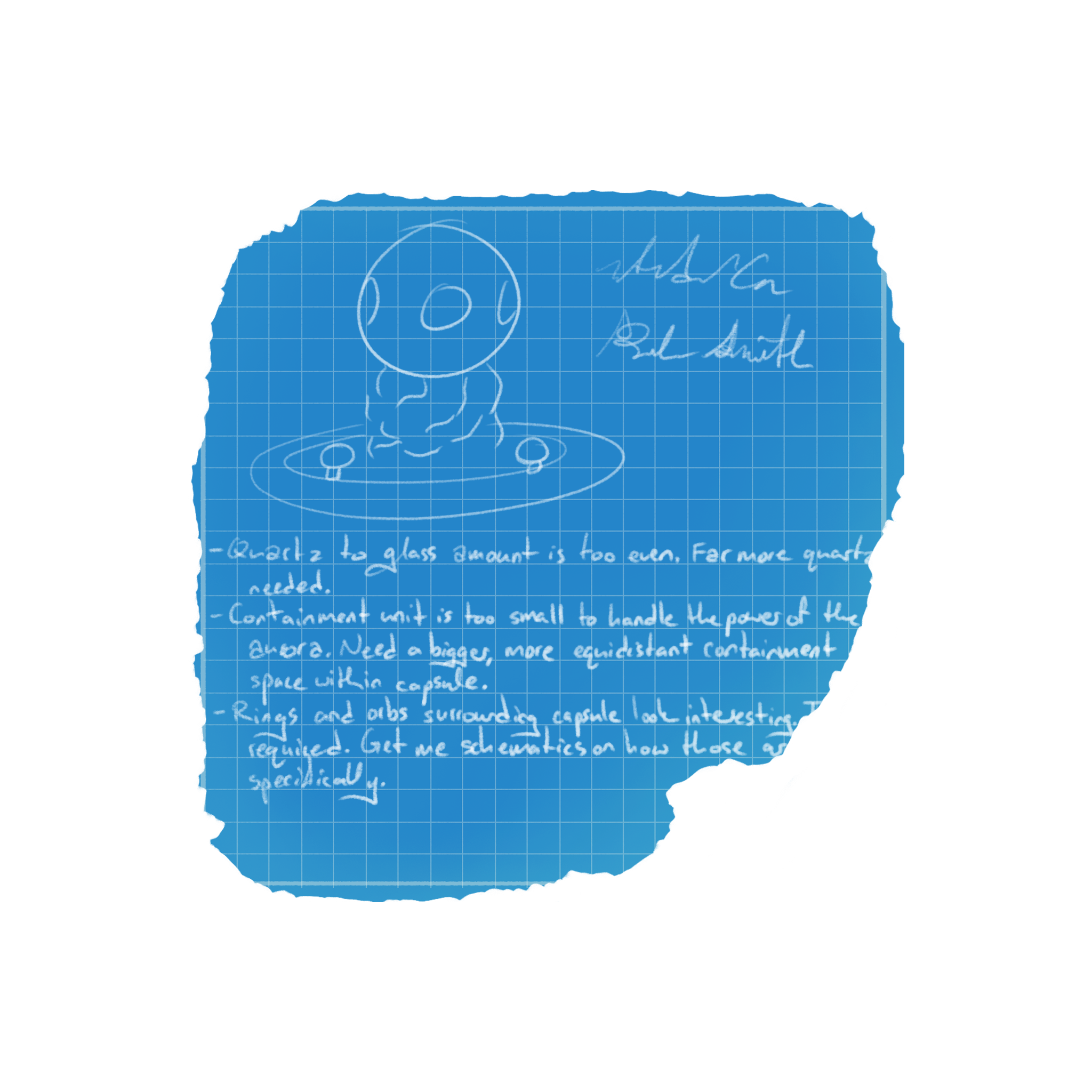
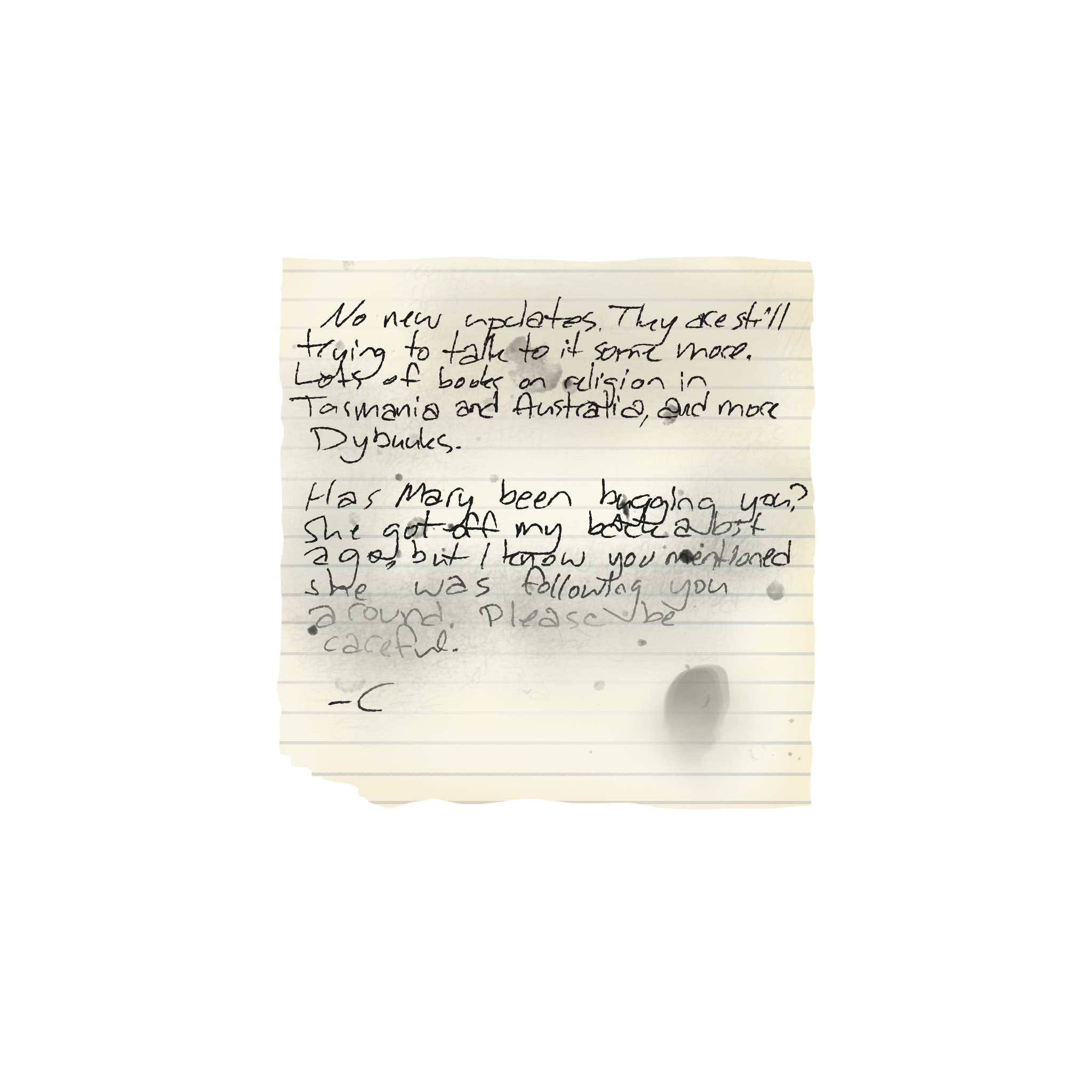

Towards the end of our first development cycle, I worked with Benton Pellet, our sound designer, to create recordings that can be found on cassette tapes around the world. He actually ended up voicing the character, John Curtis, that speaks on those logs. I told him what kind of sound and voice I was looking for in this character, and he absolutely provided. Unfortunately, these logs didn’t make it to our Alpha or Gold versions of the game, but they were used in our Alpha version’s trailer.
Development – Weeks 11-20
For Post-Production, both Wren King and I were left with very little to do. All the art got a massive overhaul from our art director and level designer, and there was very little I could be included in as a narrative designer. Our professor suggested that the two of us collaborate to create an art book for Radiant Dark to showcase not only our own work from weeks 1-10, but also to showcase the rest of the teams work throughout the full development process. Our professor, Cyril Guichard, has a physical copy of this art book.
Wren and I both worked on text and image choice for this book. I was also in charge of interviewing our team and presenting their thoughts and ideas in an eloquent manner. Wren was ultimately the one who formatted the book and chose the layouts of the pages.
 Jessica Belote